
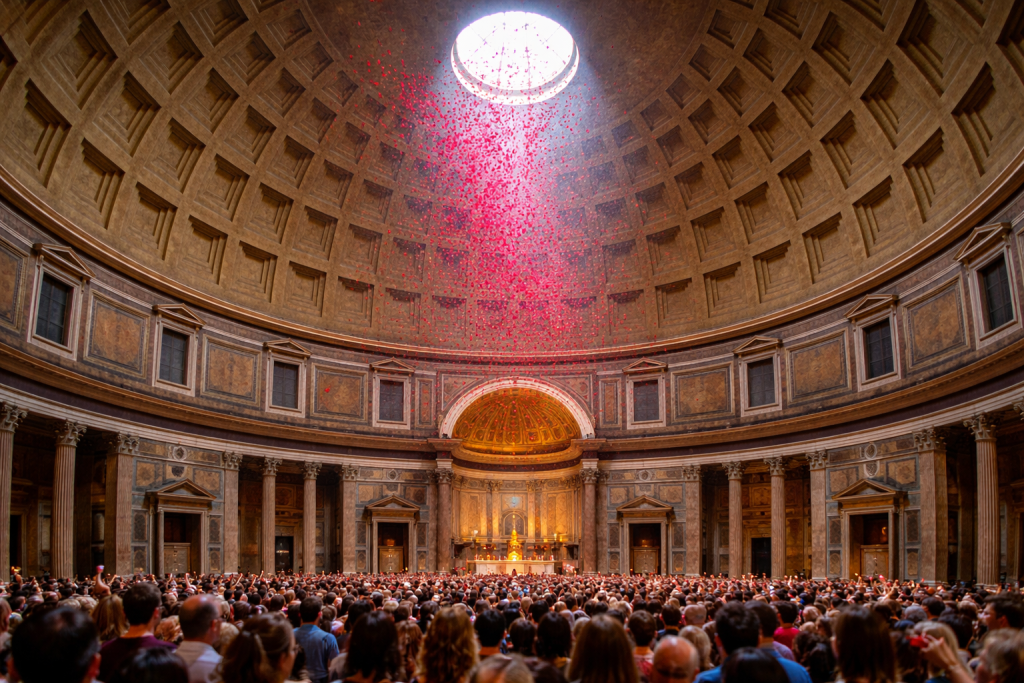
The Rose Petal Ceremony at the Pantheon (Pentecost in Rome)
Each year in early summer, one of Rome’s most quietly extraordinary traditions takes place inside the Pantheon.
During the Pentecost Mass, thousands of red rose petals fall through the oculus, drifting down from the open sky above and filling the ancient interior below. It is a brief moment, lasting only a few minutes, but it connects the building’s ancient architecture, its Christian life, and Rome’s sense of continuity in a way few events do.
For visitors, it is one of those rare occasions when Rome’s layers align perfectly — ritual, space, and history sharing the same moment.
What is the Rose Petal Ceremony?
The ceremony takes place during the Pentecost Mass, when firefighters stationed on the roof release red rose petals through the Pantheon’s oculus.
The petals symbolise the descent of the Holy Spirit, traditionally represented by tongues of fire. As they fall, they scatter across the marble floor, the altar, and the people gathered below.
Unlike many well-known Roman events, this is not a staged spectacle created for tourism. It is a real religious ceremony, held as part of the church calendar, inside one of the most significant buildings in the city.
Visitors are welcome to attend, but they are entering a functioning church during Mass, not a performance.
When does it happen?
The ceremony takes place on Pentecost Sunday, which falls 50 days after Easter. The date changes every year, usually landing in May or early June.
The rose petals are released towards the end of the main Mass, which typically begins in the late morning.
Because the exact timing can vary slightly from year to year, anyone hoping to see the petals fall should plan to arrive well in advance and be prepared to wait inside.
What to expect on the day
This is one of the Pantheon’s busiest days of the year.
Large crowds gather early, often well before the Mass begins. Entry is strictly controlled, and once capacity is reached, access is closed — even to those who have been waiting outside.
Security checks are in place, and movement inside the Pantheon is limited during the service. Photography is generally tolerated, but discretion is essential. This is a religious ceremony first and foremost.
The petals themselves fall for only a short time. If you arrive too late, or leave too early, you will miss the moment entirely.
How to see it without wasting half a day
If witnessing the rose petals is a priority, the only reliable approach is to commit to the wait.
Arrive early, expect crowds, and be prepared to stand for a significant period. There is no fast track, reservation, or guaranteed access on the day.
That said, many visitors choose a different approach: arriving later in the day, after the Mass has ended. While the petals themselves will be gone, the Pantheon often remains scattered with red fragments on the floor, offering a quieter glimpse of the aftermath without the pressure of the crowds.
This option suits those who prefer to experience the Pantheon at a calmer pace while still appreciating the significance of the occasion.
Why this tradition is so Roman
What makes the Rose Petal Ceremony distinctive is not just its beauty, but its setting.
The Pantheon was built nearly 2,000 years ago, long before it became a Christian church. Its open oculus — originally a symbol of the heavens — now frames a Christian ritual that has been celebrated here for centuries.
Rome does not separate its past into neat chapters. Instead, ancient architecture, religious life, and daily tourism coexist in the same spaces. This ceremony is a perfect example of that layered reality.
Is it worth planning your visit around?
For some visitors, absolutely.
If you enjoy living traditions, are comfortable with crowds, and don’t mind waiting for a brief but meaningful moment, the Rose Petal Ceremony can be a memorable highlight.
For others, it may be better appreciated as part of a broader understanding of Rome — something to know about, perhaps witness once, but not necessarily structure an entire day around.
Either way, it is a reminder that in Rome, history is not just something you visit. Sometimes, it still falls from the sky.